
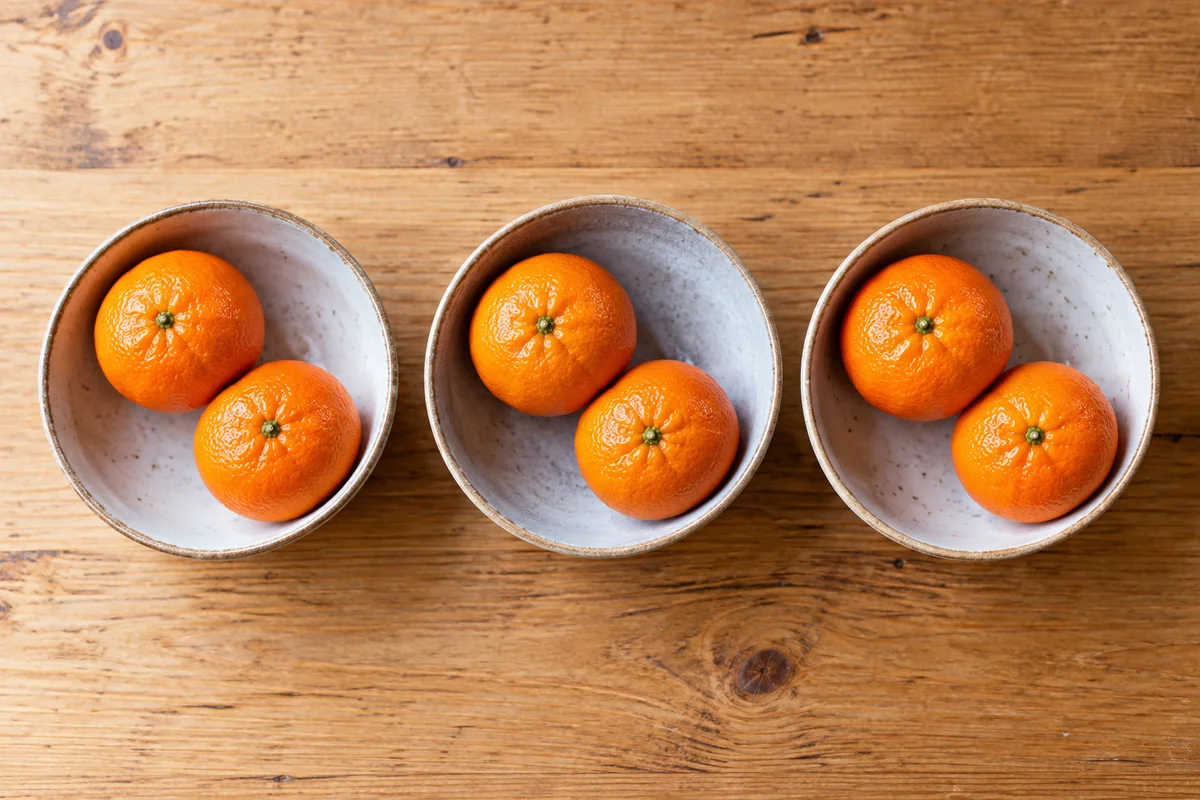
Three bowls, two pieces of fruit in each
Imagine 3 bowls. Put 2 clementines in every bowl. Each bowl has the same amount: that is what “equal groups” means.
- The first bowl gives you two clementines.
- The second bowl adds two more. You now have four.
- The third bowl adds another two. You now have six.
You could write this as 2 + 2 + 2 = 6. Multiplication gives us a shorter way to describe those equal groups.
Build your own groups
Draw three circles and put two dots in each. Count the dots or add one group at a time: two, four, six.
Keep the three circles but put four dots in each. Now you have twelve. More dots in every group means more dots altogether.
A shorter way to write equal groups
The sign × means “times”. In this lesson, 3 × 2 means “three groups of two”. We counted six clementines, so 3 × 2 = 6.
The answer to a multiplication is called the product. Here, the product is six. You may see an asterisk, *, used for multiplication on a computer.
| Groups | In each group | Total |
|---|---|---|
| 3 | 2 | 6 |
| 2 | 3 | 6 |
| 1 | 6 | 6 |
The arrangement changes, but the total stays six. You can check this by moving six real counters into those groups.
The groups must really be equal
Suppose one bowl has 2 clementines and another has 3. That is not two groups of two. The bowls hold different amounts.
Add the actual amounts instead: two and three make five. The equal-groups shortcut only fits when every group has the same size.
What about three empty bowls? Each holds zero clementines. Altogether there are still none: 3 × 0 = 0.
Try four pairs
There are four pairs of socks. A pair means two socks. How many socks are there?
Show me the steps
Count two socks for each pair: 2, then 4, then 6, then 8. Four groups of two make 8 socks.
You have now met adding, taking away and equal groups. If a sum feels slippery, sketch the groups before counting them.
For a later challenge, try counting ten groups and one more. For now, understanding the small groups is enough.
For the full picture, explore seven friendly starting points for basic arithmetic.