
BrainiLab Academy · Numbers & logic
Maths from zero: little numbers, big ideas
Build from counting and place value to the four operations, negative numbers and number routes, then compare neighbouring tens to round a number.
Start learning →
What you’ll explore
Begin with a small pile of counters and an empty space. Learn to count, build tens, add, subtract and share equally. Then grow a square, count factors and discover how a very full biscuit tin can change an average.
Each short lesson adds one idea. Read at your own pace; optional quizzes stay tucked away until you want them.
Then, bring the operations together and discover which steps to calculate first.
Step below zero and compare negative numbers using their positions on a number line.
Bring the four operations together in five untimed routes, keeping the worksheet’s left-to-right rule separate from ordinary arithmetic.
Compare a number with its neighbouring tens to understand rounding and the stated halfway rule.
Ready to use those whole-number ideas in your head? Continue with the mental maths course, or sample multiplying by 25 using a quarter of a hundred and multiplying by 99 by removing one whole group.
For a quick overview before choosing a lesson, browse seven friendly starting points for basic arithmetic, from place value to fractions and decimals.
Then explore Fractions start with equal pieces.
One discovery at a time
Your lessons, step by step
- 1
 Read →
2 min read · Quick quiz
Counting and zero: what’s in an empty cup?
Count each object once and give an empty pile its number.
Ready when you are - 2
 Read →
2 min read · Quick quiz
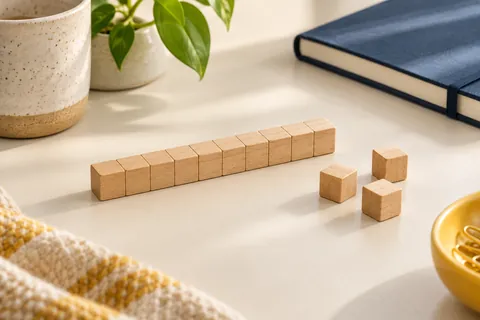
Tens and ones: why 23 and 23 tens are different
Bundle ten counters and see what each digit means.
Ready when you are - 3
 Read →
2 min read · Quick quiz
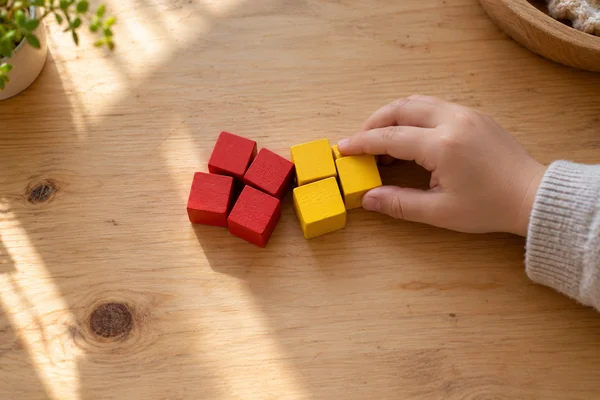
What does adding actually mean?
Join two piles and discover what the plus sign means.
Ready when you are - 4
 Read →
2 min read · Quick quiz
Subtraction explained: where did the strawberries go?
Remove counters and check what is left.
Ready when you are - 5
 Read →
2 min read · Quick quiz
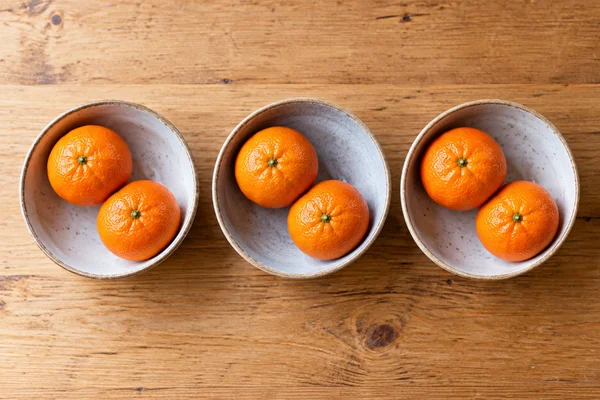
Multiplication starts with equal groups
Connect equal groups to a multiplication fact.
Ready when you are - 6
 Read →
2 min read · Quick quiz
How division works: sharing equally
Share equal amounts and explain what is left over.
Ready when you are - 7
 Read →
2 min read · Quick quiz
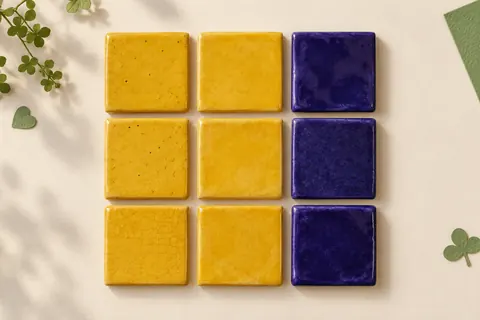
What is a square number? Start with nine tiles
Explain a square number with equal rows and columns, then spot the odd-number gaps.
Ready when you are - 8
 Read →
2 min read · Quick quiz
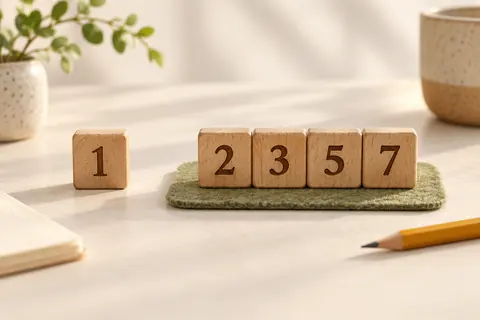
Prime numbers: why does 1 get left out?
Identify prime and composite numbers by their different positive factors, and explain why 1 is neither.
Ready when you are - 9
 Read →
2 min read · Quick quiz
Mean vs median: the biscuit tin that changes the average
Calculate a mean and a median, then explain how one unusually large value changes the story.
Ready when you are - 10
 Read →
2 min read · Quick quiz
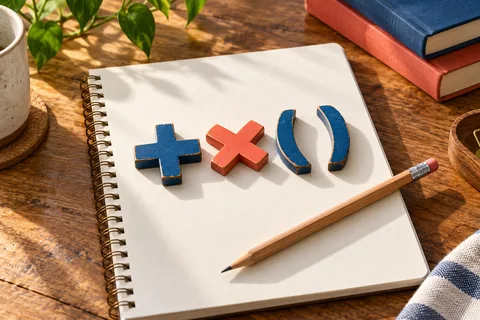
Order of operations: what should you calculate first?
Evaluate a mixed arithmetic expression using brackets and equal-priority operations from left to right.
Ready when you are - 11
 Read →
2 min read · Quick quiz
Negative numbers: what happens below zero?
Locate negative numbers, compare their order and follow a small rise through zero.
Ready when you are - 12
 Read →
3 min read · Quick quiz
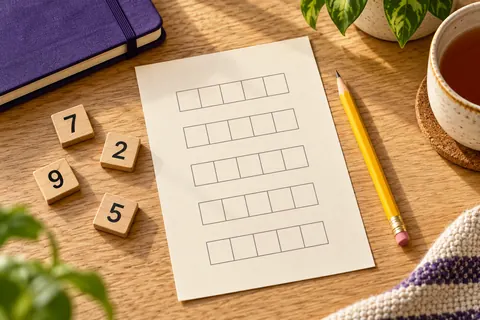
5 printable number puzzles for your next break
Follow a running total under an explicitly stated game rule and check each step.
Ready when you are - 13
 Read →
2 min read · Quick quiz
Rounding numbers to the nearest ten: which neighbour wins?
Round positive whole numbers by comparing the two neighbouring tens.
Ready when you are - 14
 Read →
2 min read · Quick quiz
Fractions start with equal pieces
Explain why a fraction needs equal parts and a defined whole.
Ready when you are
A few words worth knowing
- Add
- Put amounts together to find a total.
- Subtract
- Find what remains when an amount is taken away.
- Equal groups
- Groups that each contain the same amount.
- Zero
- The number we use for none.
- Square number
- The result of multiplying a whole number by itself.
- Factor
- A whole number that divides another whole number exactly, with no remainder.
- Prime number
- A whole number greater than 1 with exactly two different positive factors: 1 and itself.
- Mean
- The total of the values divided by how many values there are.
- Median
- The middle value in an ordered list; with an even number of values, the mean of the middle pair.
- Order of operations
- The agreed priorities for evaluating a written calculation; equal-priority operations are worked from left to right.
- Negative number
- A number less than zero.
- Running total
- The result carried from one step of a calculation into the next.
Curious to dig deeper?
- OpenStax — Add Whole Numbers
- OpenStax — Subtract Whole Numbers
- OpenStax — Multiply Whole Numbers
- OpenStax — Exponents and exponential notation
- University of Cambridge NRICH — Picturing Square Numbers
- OpenStax — Prealgebra 2e: Find Multiples and Factors
- OpenStax — Contemporary Mathematics: Prime and Composite Numbers
- OpenStax — Mean, Median and Mode
- OpenStax — Measures of Center and the Effect of Outliers
- OpenStax — Use the language of algebra: order of operations
- OpenStax — Prealgebra 2e: Introduction to integers
- BrainiLab — Number Route rules and playable game
- OpenStax Prealgebra 2e — Rounding whole numbers using a number line
- Math is Fun — Fractions
Follow the sources, explore a little further, or tell us if something needs a correction. Suggest a correction.