
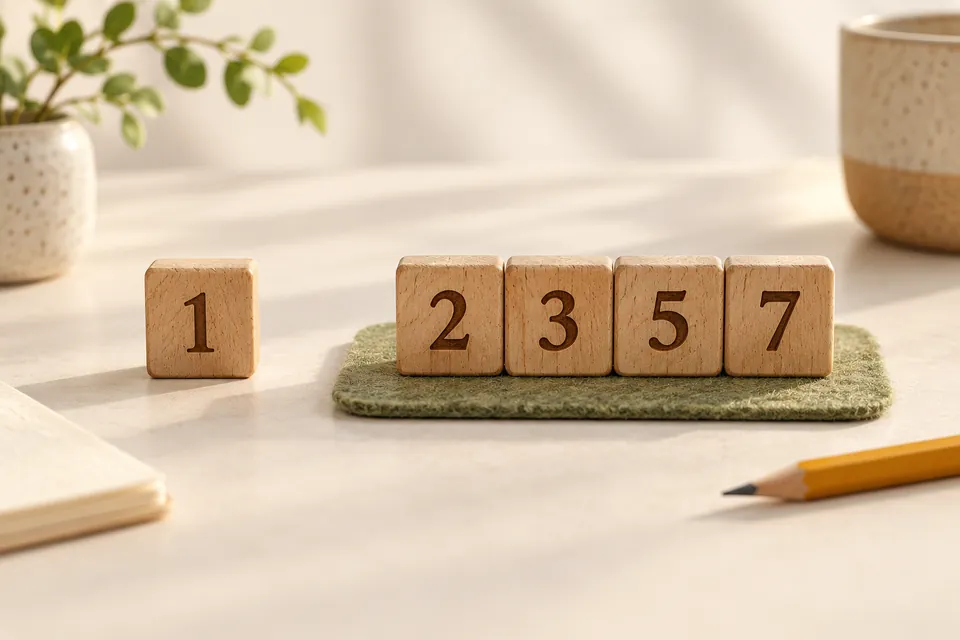
The number that refuses to split
A prime number is a whole number greater than 1 with exactly two different positive factors: 1 and itself. A factor divides a number exactly, leaving no remainder. OpenStax explains this two-factor rule.
Imagine arranging biscuits on a tray. Six biscuits can form two rows of three. Seven are less cooperative: for a complete rectangle, you can only make one row of seven or seven rows of one. Seven is prime. Nobody needs to eat the awkward biscuit.
Give every factor a seat
The positive factors of 7 are 1 and 7. The factors of 9 are 1, 3 and 9: three different factors, so 9 is composite. That means a whole number greater than 1 with more than two positive factors.
OpenStax connects primes with these possible groupings. Think back to sharing equally: can you make more than one group, with more than one item in each, and nothing left over?
Why is 1 not a prime number?
One has only one positive factor: 1. Saying “1 and itself” names the same factor twice. It does not create two different factors.
So 1 is neither prime nor composite. It fails the two-factor test for primes and the more-than-two test for composites. There is no missing category to memorise; count the different factors and the exception makes sense.
The even number allowed into the club
The first five prime numbers are 2, 3, 5, 7 and 11. Two has exactly the factors 1 and 2, making it the only even prime. Every larger even number also has 2 as a factor, alongside 1 and itself.
But being odd is not a membership pass: 9 and 15 are odd and composite. Here is a quick check for your next number: count its different positive factors. Two? Prime. More than two? Composite. Only one? You have found 1 again, sitting happily at its own table.