Turn three quarters into 75% without changing the amount. Use equivalent hundredths, then try division when a denominator will not fit neatly into 100.
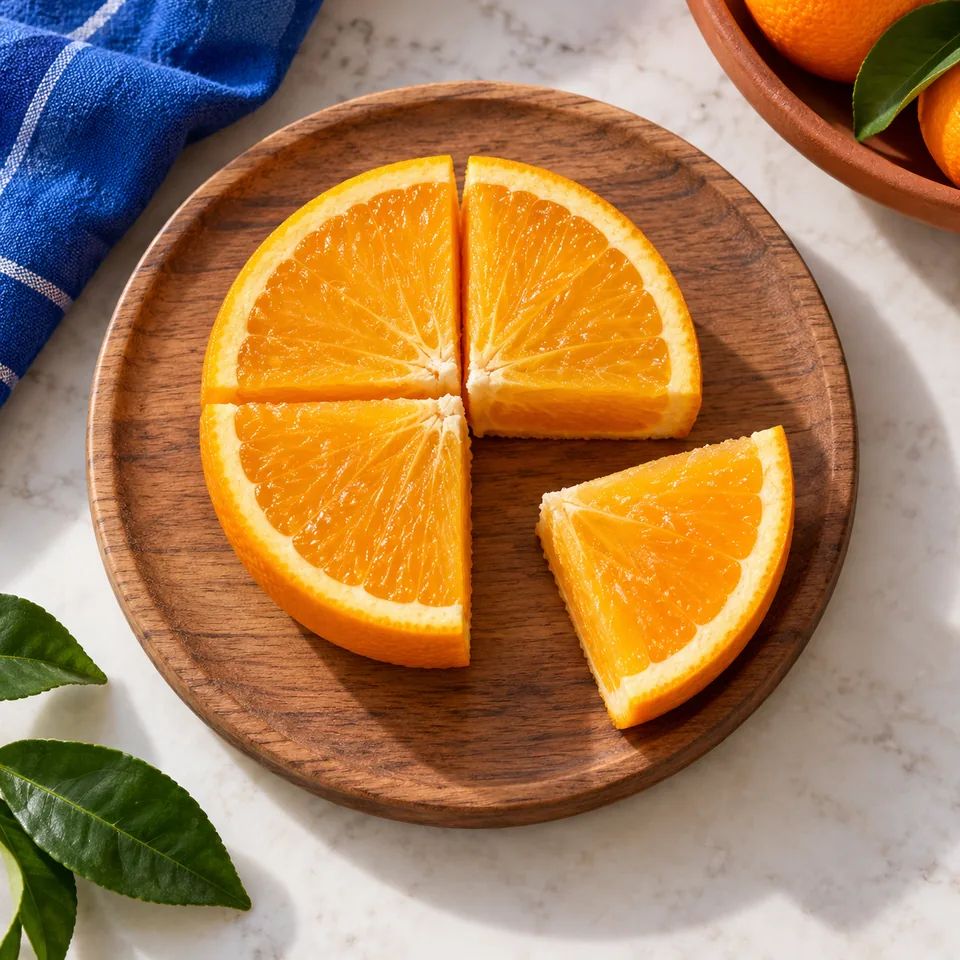
AI-generated photorealistic illustration created for BrainiLab. A staged orange illustration; the wedges illustrate parts of a whole rather than a measured mathematical diagram.
The same share, a different name
To convert a fraction to a percentage, divide the top number by the bottom number, then multiply the result by 100 and write the percent sign. You are describing the same share in hundredths. Monash University explains that percent means out of one hundred.
Imagine keeping three of four equal orange quarters. The fraction is 3/4. Calling it 75% does not create extra orange: it gives the same share a new name.
When the denominator can become 100
Four times 25 is 100. Multiply both parts of 3/4 by 25 and you get 75/100 = 75%. Multiplying the top and bottom by the same number keeps the fraction equivalent.
Try three fifths. Since 5 × 20 = 100, 3/5 = 60/100 = 60%. Only multiplying the denominator would change the amount. Both numbers must travel together.
For seven eighths, try 7 ÷ 8 = 0.875. Multiplying that decimal by 100 gives 87.5%. A percentage can include a decimal; it does not have to be a whole number.
Another example is 3/8 = 0.375 = 37.5%. It is smaller than one half, so a result below 50% makes sense. That quick size check can catch a misplaced decimal point.
Writing a share as a percentage is a different task from finding a percentage of a quantity. Here the question is “What percentage is 3/4?” The answer is 75%, regardless of whether the whole is an orange or a hundred counters. For a refresher on the decimal step, see parts of ten and decimal money.