
BrainiLab Academy · Everyday inventions
Follow the heat around a kitchen
Follow heat through a fridge, hob, air fryer and vacuum flask, then discover why a microwave moves your food.
Start learning →
What you’ll explore
The juice stays cold, the pan gets hot and the potato wedges turn crisp. Three familiar appliances manage energy in different ways.
Follow heat out of a fridge, into an induction pan and around food in moving air. These readings explain the mechanisms; use the manufacturer’s instructions for operating an appliance. The quizzes are optional.
Explore a flask that slows heat transfer, helping both a hot drink and a cold one keep their temperature.
Next, explore the uneven heating that a microwave turntable helps reduce, and why turning a bowl is different from stirring it.
One discovery at a time
Your lessons, step by step
- 1
 Read →
2 min read · Quick quiz
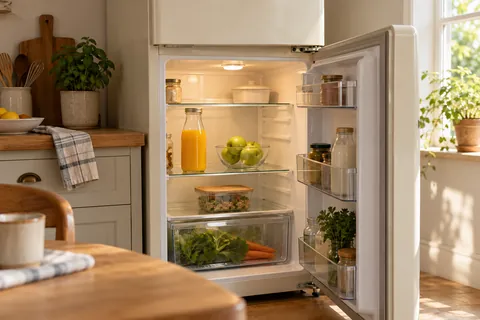
How does a refrigerator work? Follow the heat
Follow the refrigerant as it absorbs heat inside and releases heat outside.
Ready when you are - 2
 Read →
2 min read · Quick quiz
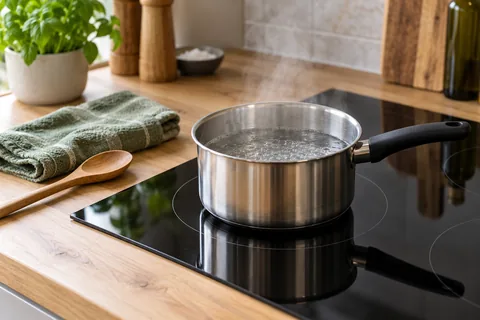
How does induction cooking work? The pan joins in
Explain the magnetic-field mechanism and recognise residual heat in the glass.
Ready when you are - 3
 Read →
2 min read · Quick quiz
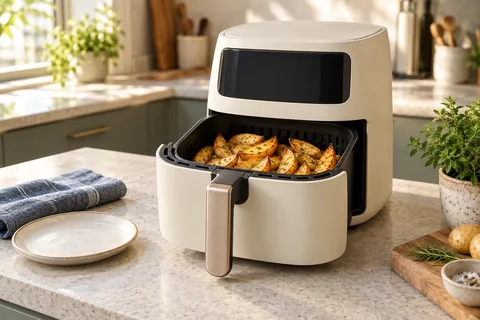
How does an air fryer work? Dinner on a hot breeze
Identify the roles of the heating element and fan.
Ready when you are - 4
 Read →
2 min read · Quick quiz
What is a vacuum flask? The gap that keeps tea hot
Distinguish insulation from heating and explain why the same flask can protect hot or cold drinks.
Ready when you are - 5
 Read →
2 min read · Quick quiz
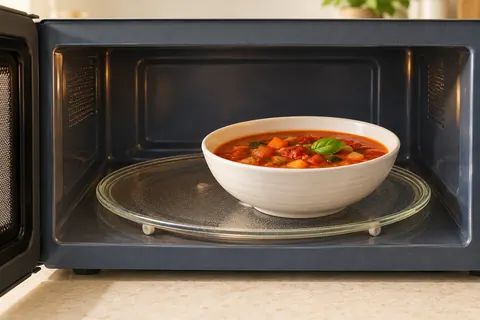
Why does a microwave have a turntable?
Explain how rotating food helps expose it to different parts of an uneven microwave field.
Ready when you are
A few words worth knowing
- Refrigerant
- The fluid in a cooling system that absorbs and releases heat as it circulates.
- Convection
- Heat transfer involving the movement of a fluid, such as air.
- Insulation
- A material or arrangement used to slow heat transfer.
Curious to dig deeper?
- NIST — How refrigerants absorb and release heat
- GE Appliances — The sealed refrigeration cycle
- Bosch — Induction coils, magnetic fields and currents in the pan
- US Department of Energy — Induction heating and compatible cookware
- Bosch UK — Residual heat on an induction hob
- Iowa State University Extension — Air Fryer Adventures, Part 1
- Philips — Hot-air circulation and direct heat in an Airfryer
- Breville — Smart Oven Air Fryer Compact instruction book
- OpenStax — Mechanisms of heat transfer
- Royal Institution — James Dewar’s vacuum flask: the 1892 object and its history
- Thermos Australia — Vacuum insulation technology: hot and cold drinks
- Whirlpool engineering patent — Microwave oven switching between predefined modes (2010), background
- GE Appliances — Microwave turntable operation
- Panasonic — NN-SF57RM flatbed microwave and its hidden antenna
- Panasonic Support — Tips on cooking evenly
Follow the sources, explore a little further, or tell us if something needs a correction. Suggest a correction.