
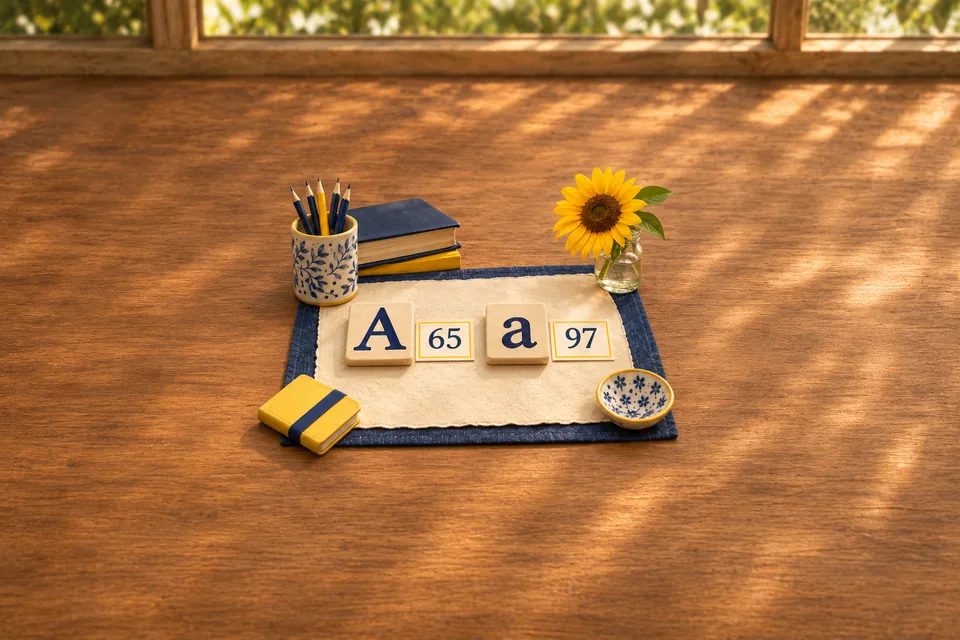
An agreed number for a character
ASCII is a character-encoding standard: it gives letters, digits and other characters agreed numerical codes. In ASCII, capital A has the decimal code 65. Lowercase a has a different code: 97.
Harvard’s CS50 guide explains these assignments. A computer using this standard does not have to guess what the sender meant by 65. Both ends use the same character table.
Read two codes together
Try a tiny example. In ASCII, 65 represents A and 66 represents B. Read the two codes in order and you get AB. Change the first code to 97 and the result becomes aB.
The numbers identify characters; they do not describe the shape of a particular font. A can look different on two screens while remaining the same character. The Unicode Consortium distinguishes a character from its drawn shape.
This is encoding, not a secret cipher. Anyone with the same public table can interpret the example. Hiding a message and agreeing how to represent its characters are different jobs.
The original limit is 128
The original ASCII set uses seven bits. Seven positions, each holding 0 or 1, allow 128 different combinations. These include letters and punctuation, but also control codes, so they are not 128 visible letters.
That limited set cannot cover all the characters people write. Unicode includes the original ASCII characters and extends much further. UTF-8 keeps the same byte values for those ASCII characters while allowing other characters too.
Compare numbers assigned to characters with the timed signals in Morse code. Follow both ideas, along with product and book identifiers, in Read the codes around you.