
Test the whole clue against each choice
Break a quiz clue into parts, then check each part against your answer. If another choice fits just as well, look for the detail that would tell them apart.
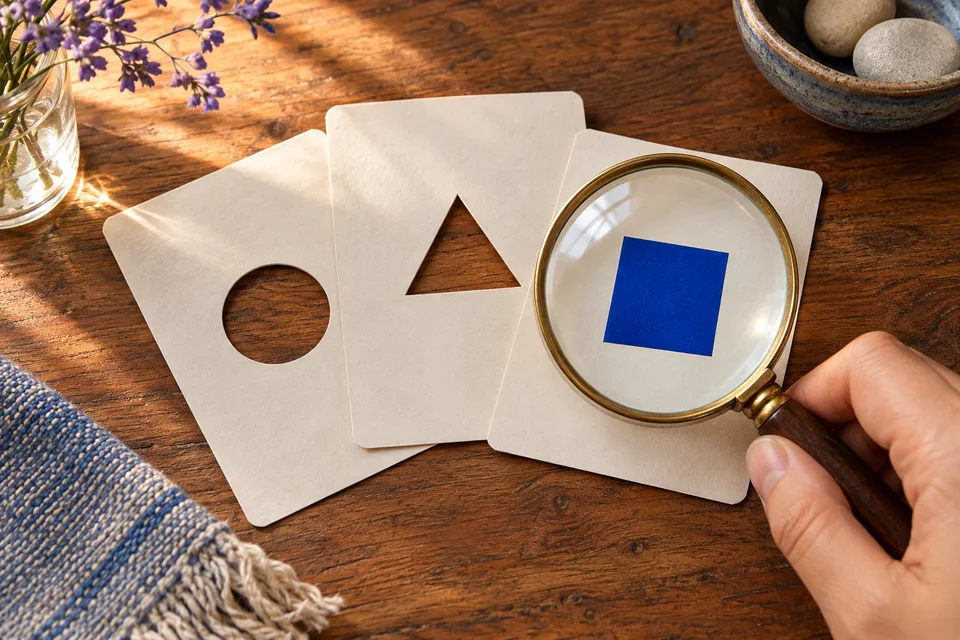
Picture four cards: a blue circle, a blue square, a yellow square and a yellow triangle. Which card is blue and square? The blue circle fits the colour but fails the shape. The yellow square does the reverse. Only the blue square fits both.
Read the word that changes the rule
Change the clue to blue or square. If “or” includes both, as it usually does in logic, three cards now fit. Try the Academy lesson on “and” and “or” to practise with real objects. OpenStax’s guide to compound statements explains how the two words work.
Now imagine the clue is “the shape isn’t blue”. A yellow triangle fits, but the yellow square does too. One other possible answer is enough to show the clue doesn’t guarantee a triangle. Try the same test in Is it certain, or just possible?
For a number pattern, check every step
Take 2, 5, 8, 11. Adding three fits each gap, so 14 is a reasonable quiz answer. A rule that adds three for the first three steps and four for the next also fits what you see, but gives 15. The constant gap is simpler; the four numbers alone don’t prove it will continue.
Work through the Academy guide to looking at the gaps for more patterns. For a shape puzzle, do the equivalent: follow a marked corner to see whether the whole shape was turned or flipped.
Name the detail that settles the clue
A picture shows snow in July. Before you guess the season, check which half of Earth the camera was in. July falls in winter in the Southern Hemisphere. Snow alone does not settle the question. Compare the two hemispheres to see why their seasons are opposite.
You can use the same habit when a logo looks familiar. Try drawing one from memory, then look up the original and circle the detail you missed. In a study using the Apple logo, familiar details turned out to be harder to recall than participants expected.
Use the context when a word has two possible readings
In a quiz about baking, you hear “add the flour”. The sound alone could also mean flower. The clue that settles the spelling is the recipe. Cambridge Dictionary calls pairs like these homophones. Try a few more examples in the lesson on same-sounding words.
The topic can change what a familiar word means. If the clue says “the server leads forty–love”, server and forty tell you that love is a score. The tennis scoring guide lets you check the next detail. If the receiver wins the next point, the score becomes 40–15.
Use the strongest clue to rule out a tempting answer
Two cave formations can both look pointed, so shape alone may leave you stuck. If the question says the formation hangs from the ceiling, the clue is where it starts. The National Park Service guide confirms it is a stalactite. Try the memory cue in stalactites vs stalagmites.
Other questions ask for a cause. If Earth’s shadow caused ordinary Moon phases, the phases would be a kind of eclipse. In the lamp-and-ball example, you can see a crescent without putting anything between the light and the ball. NASA’s Moon phases guide shows how your view of the sunlit side changes as the Moon orbits Earth.
Try it in your next round
Pick one question where two answers look plausible. Say what would rule your favourite out, then check that detail. Cornell’s guide to multiple-choice questions uses the same idea. For more short exercises on patterns, shapes and conclusions, start the Patterns and reasoning course on BrainiLab Academy.